
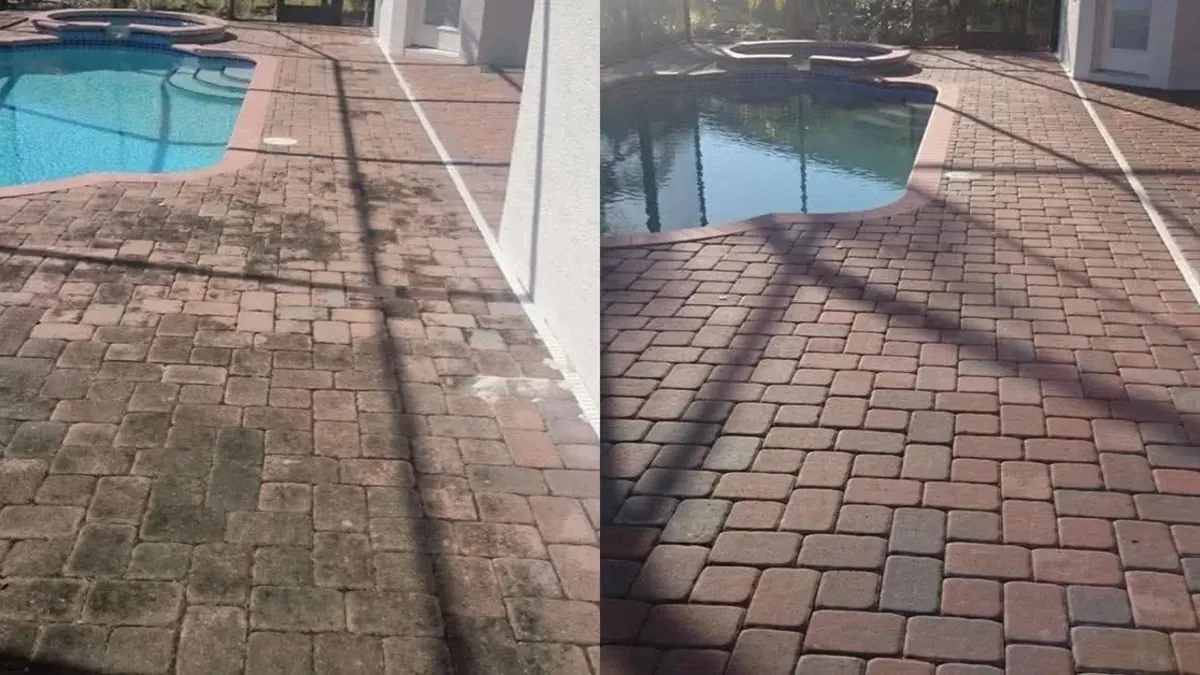
Your bare foot comes down on the wet deck and slides an inch before it grips. That slick is a thin film of algae and mold living on the surface, fed by shade, moisture and whatever blows in under the cage. On a Florida lanai it comes off with a surface cleaner and a soft wash, not a garden hose.
What the film on your deck is
It's alive. Algae and mold spores land on every deck on the Gulf Coast, and the ones that land on a surface that stays damp, shaded and a little dirty stay and grow. Pollen, oak dust and pool splash give it all it needs.
At first it's a faint green or gray tint you only notice when the deck is wet. Give it a rainy season and it gets thick enough to feel. It's the same growth that turns a cage screen green, just living on a floor people walk on. If you want the screen side of it, why the cage itself goes green covers it.
Why it's slick wet and gritty dry
Wet, the film holds a layer of water against the surface and acts like slime. Your foot or your flip-flop rides on top of it instead of gripping the deck. That's the slick.
Dry, the same film dies back and bakes down. What's left is a crust of dead growth with dirt stuck in it, and it feels rough, almost sandy, under your hand. People sweep it and call it dirt. Then a storm comes through, the crust wakes back up, and the deck is slick again.
That's the clue that it isn't dirt. Dirt doesn't turn slick when it rains.
The shaded corners and the screen edge go first
Growth follows moisture and shade, so the worst spots on a deck are predictable.
The corners of the cage stay in shadow most of the day. The strip along the screen stays damp because the screen drips after every shower and the frame shades it. Anywhere an oak, a palm or the neighbor's roofline throws shade over the cage, the floor under it stays wet longer and grows more.
Older Venice and Port Charlotte lots add mature landscaping planted right against the cage, and canal lots add moisture off the water. Both mean more shade and more damp, so the film comes back faster there.
Where to look on your own deck
Walk it in the morning, when the dew is still on it and the film shows. Look at these spots first.
- The strip along the screen: the foot or two inside the frame where the cage drips and shades the floor.
- Shaded corners: any corner the sun doesn't reach by midday.
- Under the trees: the part of the deck below the heaviest canopy or overhang.
- Steps and the pool edge: places that stay wet from splash and foot traffic.
- Paver joints and low spots: where water sits and the sand between pavers holds growth.
- The door to the house: the threshold, where everybody steps with wet feet.
If three or more of those show a green or gray tint, the whole floor has the film. Those spots are where it got a head start.
Why the cage got cleaned and the floor got forgotten
Fall is when most people finally deal with the cage. The rainy season's done, the screen is green, and the afternoon light comes through it and shows it. So the cage gets cleaned.
The floor doesn't get the same attention because it hides the problem. A green film on a deck looks like a shadow or a wet patch until you're standing on it. Nobody looks down until a foot slips.
Do the floor with the cage, though. Everything that comes off the screen and frame lands on the deck. The floor goes last, after the cage, so it gets the runoff and the rinse in one pass. We cover the screen side in our pool cage cleaning service.
Pavers, travertine and plain concrete take different handling
The film is the same on all three. What the surface can take is not.
- Plain concrete: the toughest of the three. It's flat and takes real pressure through a surface cleaner, which leaves an even finish instead of stripes. Concrete, pavers and sidewalks run at 3000 to 4000 PSI with the right tool.
- Pavers: the surface cleans the same way, but the joints are the weak point. Too much pressure aimed at the sand blows it out and leaves the pavers loose. Growth in the joints needs a steady hand and a refill of the sand afterward.
- Travertine: soft, porous stone. It holds the film deeper and it marks more easily, so it gets a gentler hand and no aggressive tip. Slower work, and it shouldn't be rushed.
Paver joints deserve their own look. Weeds and mold in your paver joints explains why they grow and what the fix looks like.
What a rinse and a broom don't do
A hose rinse moves the dirt around and does nothing to the film. It's still on the surface when the water dries.
A stiff broom scuffs the top of it. The film is in the pores of the surface, so the broom takes off the crust and leaves the roots. It's back within weeks, and often slicker than before because the scrubbing opened the surface up.
Splashing a cleaner on and hosing it off looks like it worked, because the green goes pale. Pale isn't gone. A film that isn't lifted off the surface regrows in the same spots, and runoff you didn't control ends up in the beds and on the lawn.
Signs the deck needs more than a hose
Do it yourself if it's a small patch and you can scrub it out. Pay someone when the whole floor has the film, when it comes back every rainy season, when the deck is travertine or a big paver area you don't want to damage, or when the cage and the floor both need work and you'd rather the cage went first and the floor right after.
A good visit goes in order. The plants and the pool get covered or protected. The cage and frame get cleaned first. Then the floor gets a cleaner worked into it, left to do its work, and lifted off with the right tool for that surface: a surface cleaner on concrete, a careful hand on pavers and joints, and a gentle approach on travertine. Everything gets rinsed off the deck and away from the pool, and you walk it wet to check that the slick is gone.
Mr. Pressure Cleaning prices the cage and the deck together off the same set of photos, so you can ask about both at once. For the deck side, see driveway and paver cleaning.
Common questions
How do you get slippery algae off a pool deck?
You have to lift the film off the surface, not push it around. That means a cleaner worked in, dwell time, and the right tool for the surface, then a full rinse. A hose and a broom leave the roots behind, and the slick returns after the next rain.
Why is my pool deck slippery only when it's wet?
The algae film holds water against the surface, and wet, it acts like slime under your foot. Dry, it dies back into a gritty crust and the slick disappears. It's still there, though, and the next rain brings it back.
Can pressure washing damage pavers or travertine?
Yes, if the pressure or the tip is wrong. It blows sand out of paver joints and etches soft stone like travertine. That's why each surface gets its own tool and its own distance, and why pavers get their joints looked at afterward.
Call about the deck and the cage
Tell us about the deck, the shaded corners and the strip along the screen, and you'll get a number back without anyone coming out first. Call (941) 257-8624, Mon to Sat, 8am to 7pm. Every job is quoted free, over the phone, so say what the floor is made of and whether the cage is part of it.